
Buying a Hematology Analyzer in Malaysia: From Enquiry to First Result
What to tell a supplier before anyone names a model, what the written quotation has to list, the registration checks to finish before you pay, and the installation steps that come before the first patient result.
Six steps from enquiry to go-live
An FBC machine is bought once but runs every working day for years, on reagents, controls and service visits from the same supplier. So the purchase is less about the box and more about the routine around it. The order of the steps matters: check registration before you pay, and verify the analyser before any patient result leaves the clinic. The WHO’s laboratory quality handbook puts it plainly — do not use new equipment until it is completely installed, its performance is verified and the people testing on it are trained.
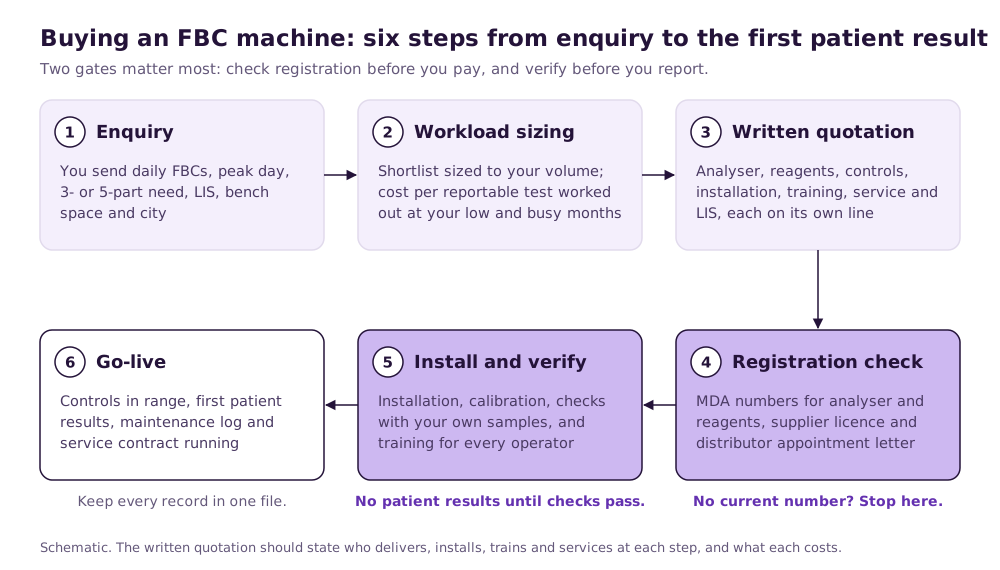
- Enquiry: you describe your workload, not a model.
- Workload sizing: a shortlist sized to your volume, with the cost per reportable test worked out.
- Written quotation: every item on its own line, including who does each job.
- Registration check: MDA numbers, the supplier’s licence and its appointment as distributor.
- Installation and verification: calibration, checks with your own samples and operator training.
- Go-live: controls in range, first patient results, and a maintenance and service routine in place.
What to send before anyone names a model
A model name is the last decision, not the first. These details let a shortlist be sized to your work rather than to a brochure — and they are what we ask for on WhatsApp before quoting.
- Facility type and who orders the tests: GP clinic, specialist clinic, hospital ward or laboratory.
- Average FBCs per day, your busiest day, your quietest month and the growth you expect over the next few years.
- Whether you need a 3-part or 5-part differential, or would like the trade-off explained.
- Any extra parameters you need, such as reticulocytes or CRP from the same sample — only some analysers offer them.
- Sample types: venous EDTA only, or capillary and pre-diluted samples for children as well.
- Who will run the analyser, and who reviews flagged results and blood films.
- Connectivity: a laboratory information system (LIS), clinic management software, or printed reports only.
- The bench, power supply, air-conditioning and waste arrangements in the room it will go into.
- Your town and state, and the date you want to start reporting results.
Read next 3-part vs 5-part explainedSpace, power and tubes for an FBC machineCBC with CRP on one sample
What the written quotation must list
WHO’s handbook advises asking, before you buy, whether installation and staff training are part of the purchase price, whether the warranty includes a trial period to confirm the instrument performs as expected, and whether maintenance can be included — and confirming the vendor’s installation responsibilities in writing. A quotation is where all of that belongs.
| Line item | What to check |
|---|---|
| Analyser and accessories | Exact model, configuration and software; MDA registration number and holder |
| Reagents | Each reagent by name, pack size, stability once opened, minimum order and how long the price is held |
| Cost per reportable test | Worked out at your quiet, normal and busy volumes, including start-up, shutdown, controls and repeats |
| Controls and calibrators | Levels, how often they are run, who supplies them and their registration |
| Installation and calibration | Who installs and calibrates, the site requirements and the installation date |
| Verification support | What help is given with precision and comparison checks before you report patients |
| Operator training | Who trains, how many staff, and training for staff who join later |
| Warranty | Length, start date (delivery or installation) and what is excluded |
| Service after warranty | Contract options, response time in your state, and a loan or backup arrangement |
| LIS or software link | Included or separate, and who configures it with your system |
| Lead time, payment and validity | Delivery lead time, deposit and balance terms, and how long the prices hold given exchange-rate changes |
Read next Cost per test, and comparing two quotesReading the spec sheet
Outright purchase, reagent rental or lease
The same analyser can be paid for in different ways. Ask for each option on the same workload so they can be compared over the same period.
Outright purchase
You pay for the analyser and own it, then buy reagents as you need them. Most flexible if your volume is uncertain or seasonal.
Reagent rental
The analyser is placed with you against a commitment to buy reagents; its cost is built into the reagent price. Works when volume is steady and predictable.
How reagent rental worksLease or instalments
A fixed monthly payment for the analyser, separate from reagents. Spreads the cost without tying you to a reagent volume.
Read next Budget 2027 tax changes for clinic equipment (autoclave.my)
Checks to finish before you pay
Under section 15 of the Medical Device Act 2012 (Act 737), a company may import, export or place a registered medical device on the market only if it holds an MDA establishment licence. MDA Circular Letter No. 1/2026, in force since 28 January 2026, tells public and private healthcare facilities buying by tender to obtain three documents from the supplier before the purchase is finalised. Ask for the same three when you buy by quotation.
- A copy of the supplier’s establishment licence as a medical device distributor, in its own name.
- The valid MDA registration certificate for the analyser — and the registration numbers of the reagents, controls and calibrators you will use with it.
- A letter appointing the supplier as distributor, from the authorised representative or the original establishment.
- Check the numbers yourself on the MDA’s public register, which searches both registered devices and licensed establishments.
- Ask where reagents are stocked and how long an order takes to reach your town.
- Ask who services the analyser in your state, and get the response time in writing.
Read next Checking an MDA registrationHow to vet a supplierBuying a used or demo analyser
Installation, verification and go-live
- Get the room ready before delivery: bench, power with surge protection or a UPS, a stable room temperature and a biohazard waste container.
- Installation and calibration by the person the quotation names, with a written installation report.
- Verification before patients: repeat precision, a comparison with your current laboratory on your own samples, background and carryover checks — with the results kept on file.
- Run controls and confirm they are in range before the first patient sample.
- Train every operator, including part-time and weekend staff, on daily start-up, maintenance, flags and what to do when controls fail.
- Keep the installation report, calibration record, training records, registration numbers and warranty dates in one file, with the next service date labelled on the analyser.
Read next Installation checklist: site preparation to sign-offVerifying a new analyserDaily QC and Levey-Jennings chartsWhat a service contract should cover
Related guides
Hematology Analyser supply near you
Written quotes for clinics across Malaysia, handled from Batu Caves, Kota Kinabalu and Kuching.
- Hematology Analyser Kuala LumpurKuala Lumpur
- Hematology Analyser SelangorSelangor
- Hematology Analyser Petaling JayaSelangor
- Hematology Analyser Shah AlamSelangor
- Hematology Analyser KlangSelangor
- Hematology Analyser SerembanNegeri Sembilan
- Hematology Analyser MelakaMelaka
- Hematology Analyser Johor BahruJohor
Sources and further reading
- World Health Organization. Laboratory quality management system handbook (2011), chapter 3: Equipment
- Medical Device Authority. Circular Letter No. 1/2026: procurement of medical devices for healthcare facility institutions (28 January 2026)
- Medical Device Authority. Establishment licence information (section 15, Act 737)
- Medical Device Authority. Malaysia Medical Device Register: registered devices and licensed establishments
Frequently asked questions
Where can I buy a hematology analyzer in Malaysia?
Do you list analysers for sale with prices?
What should the price of an FBC machine include?
Do I need to verify a new analyser before using it?
Should I buy a new or a used FBC machine?
How long does it take from order to the first patient result?
Get a written quotation
Tell us your clinic or lab type, daily workload and location. We match suitable models and send a written quotation that states who handles delivery, installation and training, and what each costs.
010-905 2891 · Mon–Sat, 9:00 am – 6:00 pm