
CLIA-Waived CBC Analyzers, and What a Malaysian Clinic Needs Instead
“CLIA-waived” is a US label for tests simple enough to run outside a certified laboratory. What it means, which CBC analyser has earned it, and why it carries no legal weight in Malaysia.
What CLIA is
The Clinical Laboratory Improvement Amendments (CLIA) are US federal rules for any laboratory that tests human samples. The Food and Drug Administration (FDA) places each test system in one of three categories, from least to most complex: waived, moderate complexity and high complexity. The Centers for Medicare & Medicaid Services (CMS) certifies laboratories to match, and a site holding only a Certificate of Waiver may run waived tests and nothing else.
| Category | How a test gets there | What it means for the site |
|---|---|---|
| Waived | Waived by regulation, cleared for home use, or granted a CLIA Waiver by Application | May be run under a Certificate of Waiver, following the maker’s instructions |
| Moderate complexity | Scores 12 or less on the FDA scorecard | Needs a laboratory certificate, qualified staff and proficiency testing |
| High complexity | Scores above 12, or not yet categorised | Stricter staff and quality requirements again |
How a CBC analyser earns a waiver
The maker must show that untrained operators at a waived site get results as reliable as a laboratory’s. That is hard for a full blood count, because abnormal samples and flags normally need a trained eye. The FDA cleared the first CLIA-waived CBC analyser, Sysmex America’s XW-100, in November 2017 through the dual submission pathway, which combines 510(k) clearance with a CLIA Waiver by Application. To make it work, Sysmex cut the reported parameters to 12 and gave operators simple instructions for flagged or out-of-range results.
| Feature | XW-100 for CLIA-waived use |
|---|---|
| Operator | A minimum of a high-school diploma or equivalent |
| Sample | Venous whole blood in K2 or K3 EDTA only |
| Parameters | 12: WBC, RBC, HGB, HCT, MCV, PLT, and lymphocytes, neutrophils and “other WBC” as % and absolute counts |
| Method | Direct current (impedance) with hydrodynamic focusing; haemoglobin by photometry |
| Calibration | Factory-calibrated |
| Flagging | Simplified: results likely to be unreliable are suppressed by built-in rules |
| Not for | Chronic blood disorders, oncology patients, the critically ill, and children under 2 |
Read next Sysmex XW-100 in detail
Which CBC analysers are CLIA-waived?
As of November 2026, the CLIA-waived CBC analyser we could verify in FDA documents is the Sysmex XW-100: the original 2017 version and a modified version reviewed in 2021 (510(k) K210346, CLIA waiver application CW210002). Other compact analysers are sold with FDA clearance for laboratory use, which is not the same thing. Before relying on a “CLIA-waived” claim for any model, look it up in the FDA’s CLIA database, which lists the complexity category of each test system.
- Ask for the FDA CLIA categorisation record, not a brochure line.
- Check that the waiver covers the exact model and software version on offer.
- Check the sample types it covers: the XW-100’s waiver is for venous EDTA blood, not finger-prick samples.
Read next Point-of-care blood analysers
Why “CLIA-waived” has no legal effect in Malaysia
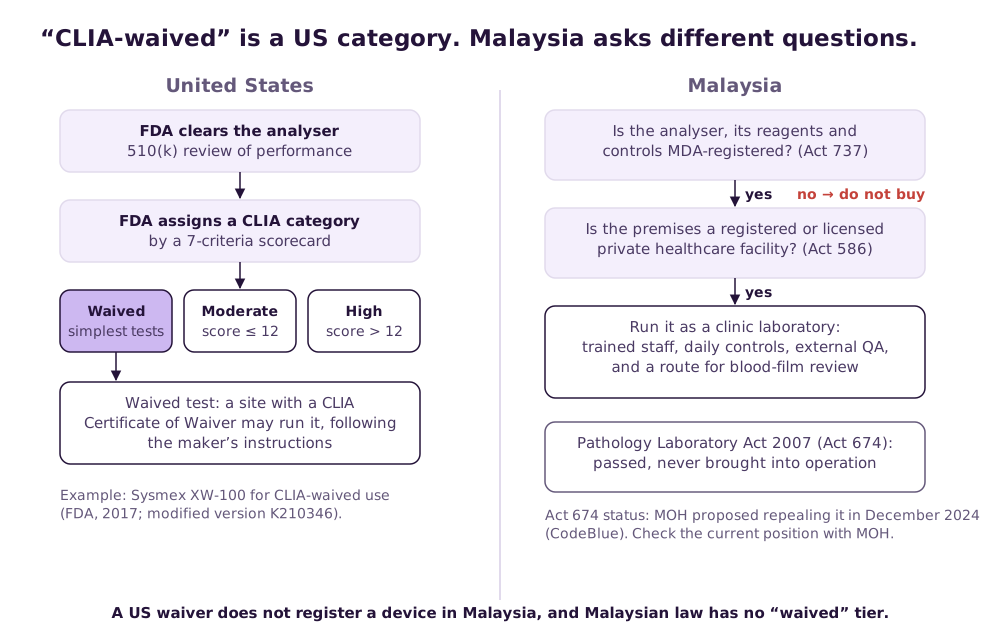
CLIA is US law. Malaysia has no waived category for laboratory tests, and a US waiver does not register a device, licence a premises or qualify an operator here. Three Malaysian laws matter instead.
| Law | What it requires | What to do |
|---|---|---|
| Medical Device Act 2012 (Act 737) | Every medical device, including IVD analysers, reagents and control material, must be registered with the Medical Device Authority (MDA) before it is placed on the Malaysian market | Ask for the registration numbers and check them on the MDA public register |
| Private Healthcare Facilities and Services Act 1998 (Act 586) | Private clinics and other healthcare facilities must be registered or licensed; MOH said in April 2026 that blood collection for health screening may only take place at such premises | Run FBCs only at a registered or licensed facility |
| Pathology Laboratory Act 2007 (Act 674) | Would license private pathology laboratories, but has never been brought into operation; in December 2024 MOH proposed repealing it | As passed, it excluded side-room laboratories in doctors’ and dentists’ clinics testing their own patients; watch for its replacement |
Read next Checking MDA registrationBlood tests in pharmacies and Act 586
Questions to ask when a supplier says “CLIA-waived”
The phrase is often used in sales material to mean “simple to use”. That may be true, but it is a claim about US status, not about registration or support here. These questions turn it into something you can check.
- Is this exact model, with this software version, waived in the FDA CLIA database, and for which sample types?
- Is the model registered with the MDA, and are its reagents and control material registered too? What are the numbers?
- Which parameters does the waived configuration report? A waived set-up may omit indices such as MCH that Malaysian thalassaemia screening relies on.
- Who supplies reagents and controls in Malaysia, and who services the analyser in your state?
- What does a reportable FBC cost at your real daily volume, including start-up, shutdown and controls?
Read next Reading an analyser spec sheet
What is optimal for a Malaysian GP clinic
You do not need a US waiver to run a reliable FBC in a clinic. You need a registered analyser, a registered premises and a routine that catches errors. The features that earned the XW-100 its waiver are still worth looking for, because they protect a busy clinic whose staff are not laboratory scientists.
- MDA registration numbers for the analyser, its reagents and controls.
- Two levels of control each testing day and an external quality assessment (EQA) scheme.
- A written route for blood-film review when results are flagged.
- Training records for every operator.
| Feature | Why it helps in a clinic |
|---|---|
| Factory or locked calibration | Staff cannot shift the calibration by mistake |
| QC lock-out | The analyser refuses patient samples until controls pass |
| Result suppression on doubtful samples | An unreliable value is withheld instead of printed |
| Clear “refer for further testing” messages | Non-specialist staff know when a sample must go to a laboratory |
| Local reagent and service support | Waiver or not, an analyser without reagents in your state stops working |
Read next QC and EQA for clinicsChoosing an analyser for a GP clinic
Related guides
Hematology Analyser supply near you
Written quotes for clinics across Malaysia, handled from Batu Caves, Kota Kinabalu and Kuching.
- Hematology Analyser Kuala LumpurKuala Lumpur
- Hematology Analyser SelangorSelangor
- Hematology Analyser Petaling JayaSelangor
- Hematology Analyser Shah AlamSelangor
- Hematology Analyser KlangSelangor
- Hematology Analyser SerembanNegeri Sembilan
- Hematology Analyser MelakaMelaka
- Hematology Analyser Johor BahruJohor
Sources and further reading
- US FDA. CLIA categorizations
- US FDA decision summary K210346: XW-100 Automated Hematology Analyzer for CLIA-waived use
- ADLM Clinical Laboratory News. Sysmex CBC test becomes first to receive CLIA waiver (2018)
- US FDA CLIA database (test system categorisation search)
- Laws of Malaysia: Private Healthcare Facilities and Services Act 1998 (Act 586)
- CodeBlue. MOH moots repealing Pathology Lab Act that was never enforced (December 2024)
Frequently asked questions
Is there a CLIA waiver in Malaysia?
Can I buy a CLIA-waived CBC analyser for my clinic in Malaysia?
Does CLIA-waived mean more accurate?
Which CBC analyser was the first to be CLIA-waived?
Who may run an FBC machine in a Malaysian clinic?
Get a written quotation
Tell us your clinic or lab type, daily workload and location. We match suitable models and send a written quotation that states who handles delivery, installation and training, and what each costs.
010-905 2891 · Mon–Sat, 9:00 am – 6:00 pm