
Hematology Analyzer Reagents: What They Do and How to Store Them
Reagents are the largest recurring cost of an FBC machine and a common source of QC problems. Here is how to choose, store and use them.
What each reagent does
| Reagent | Job | Used on |
|---|---|---|
| Diluent | Dilutes the sample and carries cells through the counting aperture; also rinses the fluid path | 3-part and 5-part |
| Lyse | Breaks open red cells so white cells can be counted and haemoglobin measured | 3-part and 5-part (5-part often uses more than one) |
| Cleaner | Removes protein deposits from the aperture and tubing | 3-part and 5-part |
| Stain or fluorescent dye | Marks white cells for the optical differential | 5-part, depending on the model |
| Control blood and calibrator | Not reagents strictly, but recurring consumables for QC and calibration | 3-part and 5-part |
How diluent and lyse work
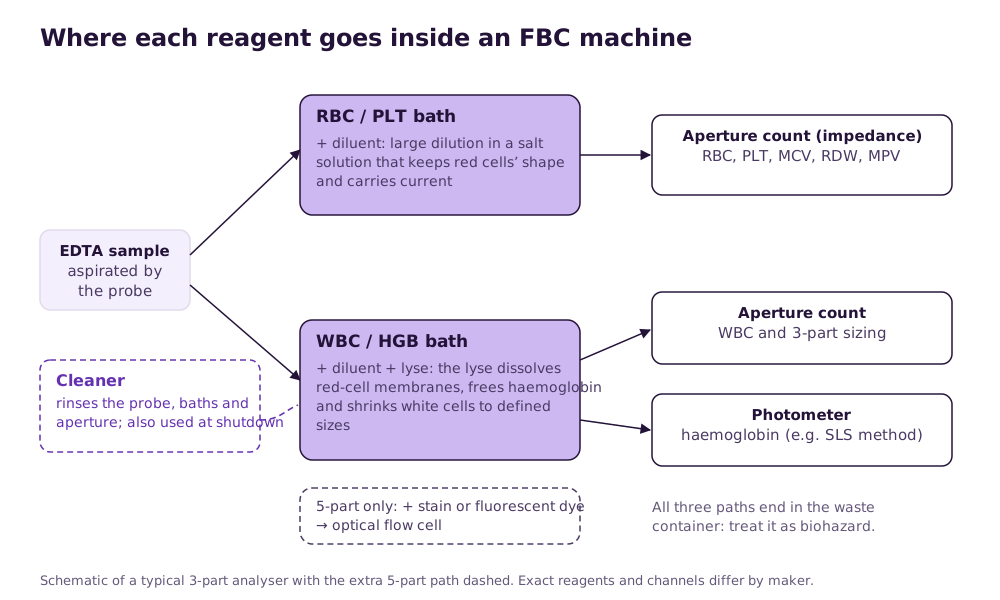
Inside the analyser the sample is split between two baths, and each reagent has a job that the count depends on. When a reagent is wrong, old or contaminated, the fault shows up in a predictable place.
Diluent
An isotonic, buffered salt solution. It keeps red cells at their true size, conducts the current the impedance count depends on and carries cells through the aperture. A contaminated or wrong diluent shows up first as a high background count.
Lyse
A detergent-based reagent that dissolves red-cell membranes. It frees haemoglobin for the photometer, in many analysers as cyanide-free SLS-haemoglobin, and shrinks white cells to sizes typical of each type, which is what a 3-part analyser sorts. Too little lyse leaves red cells that are counted as white cells.
Cleaner
Removes the protein film blood leaves on the aperture and tubing. A dirty aperture gives clogs, noisy pulses and a drifting MCV.
Stains and dyes (5-part)
Bind nucleic acids or cell components so white cells can be separated by fluorescence in the optical channel.
Read next How a haematology analyser works
Storage and stability
- Store at the temperature on the label, out of direct sun and away from heat sources.
- Note two limits: the expiry date of the unopened pack and the opened (on-board) stability.
- Write the opening date on every container and use the oldest stock first.
- Do not top up or combine part-used containers.
- Control blood is usually kept refrigerated and has a short opened life — follow its insert exactly.
- Run controls after every reagent lot change and record the lot number.
Read next QC after a reagent lot change
Closed vs open reagent systems
Closed system
The analyser is designed for the maker’s own reagents, sometimes identified by barcode or tag. Performance is predictable, but you have a single source for pricing and supply.
Open system
Third-party reagents may be used. They can cost less, but must be validated on your analyser, may affect warranty, and must themselves be MDA-registered.
What to ask
Which reagents are validated for the model, whether others void the warranty, and how long reagent prices are fixed.
Planning reagent supply
- Estimate use from patient samples plus start-up, shutdown, background checks and controls.
- Match pack sizes to opened stability at your real daily volume.
- Keep a buffer for dengue-season peaks and agree order lead times with the supplier.
- Ask whether deliveries can come from a single lot to reduce QC shifts.
Read next Planning stock for dengue seasonMDA registration for reagentsReagent rental and minimum commitmentsControls and calibrators: what to order
Related guides
Hematology Analyser supply near you
Written quotes for clinics across Malaysia, handled from Batu Caves, Kota Kinabalu and Kuching.
- Hematology Analyser Kuala LumpurKuala Lumpur
- Hematology Analyser SelangorSelangor
- Hematology Analyser Petaling JayaSelangor
- Hematology Analyser Shah AlamSelangor
- Hematology Analyser KlangSelangor
- Hematology Analyser SerembanNegeri Sembilan
- Hematology Analyser MelakaMelaka
- Hematology Analyser Johor BahruJohor
Sources and further reading
- Boule Diagnostics. Understanding histograms: Medonic M32 white paper (dilution and haemolytic reagents)
- Oshiro I, Takenaka T. New method for hemoglobin determination by using sodium lauryl sulfate (SLS). Clinical Biochemistry, 1982
- US FDA decision summary K210346: XW-100 (diluent and lyse reagents, principles of operation)
- Medical Device Authority. Public register of medical devices
Frequently asked questions
Can I use a different brand of diluent on my analyser?
Why did my QC shift after opening a new reagent box?
Are haematology reagents regulated in Malaysia?
What does the lyse reagent do in an FBC machine?
What is diluent in an FBC machine?
Get a written quotation
Tell us your clinic or lab type, daily workload and location. We match suitable models and send a written quotation that states who handles delivery, installation and training, and what each costs.
010-905 2891 · Mon–Sat, 9:00 am – 6:00 pm