
FBC Normal Range: Malaysian Adult Values and WHO Haemoglobin Cut-offs
Reference intervals measured in healthy Malaysian adults, the WHO’s 2024 haemoglobin thresholds for anaemia by age and pregnancy, and how to read a value that sits just outside the range.
Why there is no single normal range
A reference interval is the range that holds the middle 95% of results from healthy people, measured on a particular analyser in a particular population. It shifts with age, sex, pregnancy, altitude and the analyser used. A 2014 study of healthy adults in Malaysia found that haemoglobin, red-cell count, haematocrit and platelet count differed significantly from published ranges for other populations, and argued for local intervals over imported ones. The range printed on your laboratory’s report is the one that applies to your result.
- By definition about 1 healthy person in 20 falls outside a 95% interval on any single test.
- Analysers differ slightly, so each laboratory verifies or sets its own range.
- Children’s ranges change with age and are set separately.
Adult reference intervals measured in Malaysia
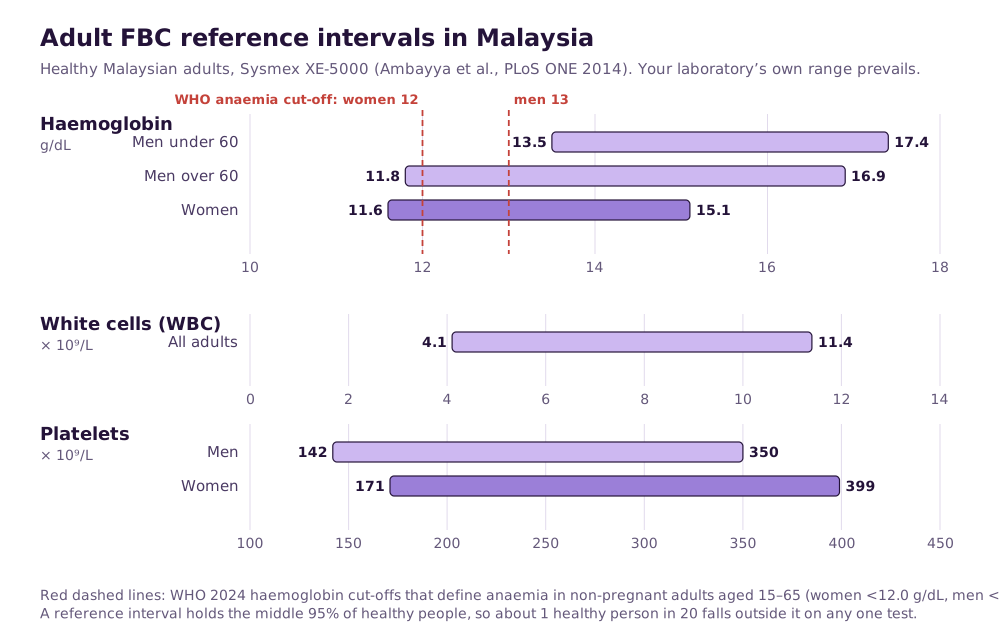
Ambayya and colleagues, working at Hospital Ampang with Universiti Malaysia Sarawak, measured healthy adults of Malaysia’s three main ethnic groups on a Sysmex XE-5000 and published these intervals (mean ± 1.96 SD) in 2014. Of 2,440 people with complete data, 1,376 (907 women and 469 men) met the criteria for the healthy reference group. Sex and age changed the results; ethnicity and smoking made little difference.
| Test | Men under 60 | Men over 60 | Women |
|---|---|---|---|
| Haemoglobin (g/dL) | 13.5–17.4 | 11.8–16.9 | 11.6–15.1 |
| Red cells (× 10¹²/L) | 4.53–5.95 | 3.86–5.62 | 3.87–5.21 |
| Haematocrit (%) | 40.1–50.6 | 35.7–48.9 | 35.1–44.9 |
Indices, white cells and platelets
These intervals from the same study apply to all adults unless a sex is shown.
| Test | Reference interval | What a result outside it usually prompts |
|---|---|---|
| MCV | 80.6–95.5 fL | Low: small red cells, as in iron deficiency or thalassaemia trait |
| MCH | 26.9–32.3 pg | Low: the usual first clue to thalassaemia carrier status |
| MCHC | 31.9–35.3 g/dL | Far above the range: usually a sample problem, not a patient problem |
| RDW-CV | 12.0–14.8% | High: red-cell sizes vary, as in early iron deficiency |
| RDW-SD | 37.5–48.1 fL | The same spread, measured in fL |
| White cells (WBC) | 4.1–11.4 × 10⁹/L | Read the differential in absolute counts |
| Platelets, men | 142–350 × 10⁹/L | Low: check the platelet histogram and a film for clumps |
| Platelets, women | 171–399 × 10⁹/L | Women ran higher than men in this study |
Read next Thalassaemia screening on the FBCWhen MCHC is impossible: flags
When is haemoglobin low enough to call anaemia?
A reference interval describes healthy people; an anaemia cut-off is a decision threshold. In 2024 the WHO updated its haemoglobin cut-offs, setting them at the 5th percentile of haemoglobin in healthy populations. They are applied after adjusting for altitude and for smoking.
Why the two numbers differ for women
The lower limit of the Malaysian women’s reference interval, 11.6 g/dL, is below the WHO anaemia cut-off of 12.0 g/dL. The two answer different questions. The same Malaysian study attributed about 70% of the anaemia in premenopausal women to iron deficiency, so a woman at 11.8 g/dL is inside the local reference interval yet meets the WHO definition of mild anaemia, and many doctors would check her iron status.
Children
Children’s haemoglobin, white-cell and platelet counts change with age, with newborns and infants differing most from adults. Laboratories report age-specific ranges, which vary by analyser, so we have not reproduced paediatric ranges here. Use the range on the report, and the WHO cut-offs above to judge anaemia.
| Group | Anaemia if Hb is below | Mild | Moderate | Severe |
|---|---|---|---|---|
| Children 6–23 months | 10.5 | 9.5–10.4 | 7.0–9.4 | Below 7.0 |
| Children 24–59 months | 11.0 | 10.0–10.9 | 7.0–9.9 | Below 7.0 |
| Children 5–11 years | 11.5 | 11.0–11.4 | 8.0–10.9 | Below 8.0 |
| Children 12–14 years | 12.0 | 11.0–11.9 | 8.0–10.9 | Below 8.0 |
| Women 15–65, not pregnant | 12.0 | 11.0–11.9 | 8.0–10.9 | Below 8.0 |
| Men 15–65 | 13.0 | 11.0–12.9 | 8.0–10.9 | Below 8.0 |
| Pregnancy, first trimester | 11.0 | 10.0–10.9 | 7.0–9.9 | Below 7.0 |
| Pregnancy, second trimester | 10.5 | 9.5–10.4 | 7.0–9.4 | Below 7.0 |
| Pregnancy, third trimester | 11.0 | 10.0–10.9 | 7.0–9.9 | Below 7.0 |
Units on the report, and how to convert them
Malaysian laboratories mostly report haemoglobin in g/dL and cell counts per litre, but analysers, older reports and overseas references use other units. Converting before comparing avoids the most common misreading.
| Test | Unit used on this page | Same value in another unit |
|---|---|---|
| Haemoglobin | g/dL | Multiply by 10 for g/L (12.0 g/dL = 120 g/L) |
| White cells and platelets | × 10⁹/L | The same number as × 10³/µL (4.1 × 10⁹/L = 4.1 × 10³/µL = 4,100 per µL) |
| Red cells | × 10¹²/L | The same number as × 10⁶/µL |
| Haematocrit | % | Divide by 100 for L/L (40% = 0.40 L/L) |
| MCV and RDW-SD | fL | A femtolitre is 10⁻¹⁵ litre; the unit is the same everywhere |
What is optimal: reading a result just outside the range
| Situation | Check first | Then |
|---|---|---|
| One value slightly outside, patient well | Sample age, tube type, clots and mixing | Repeat in context and compare with previous results |
| Low Hb with low MCV and MCH | Iron status and thalassaemia screening | Follow the thalassaemia screening pathway |
| Low platelets | The platelet histogram and a film for clumps | Recollect in citrate if the platelets are clumped |
| High WBC | The differential in absolute counts | A film if flagged or unexplained |
| Rising HCT with falling platelets in a febrile patient | The dengue phase and the daily trend | Follow the MOH dengue clinical practice guideline |
Read next Dengue 2026: FBC in the clinicCara baca keputusan FBC (BM)
Related guides
Hematology Analyser supply near you
Written quotes for clinics across Malaysia, handled from Batu Caves, Kota Kinabalu and Kuching.
- Hematology Analyser Kuala LumpurKuala Lumpur
- Hematology Analyser SelangorSelangor
- Hematology Analyser Petaling JayaSelangor
- Hematology Analyser Shah AlamSelangor
- Hematology Analyser KlangSelangor
- Hematology Analyser SerembanNegeri Sembilan
- Hematology Analyser MelakaMelaka
- Hematology Analyser Johor BahruJohor
Sources and further reading
- Ambayya A, et al. Haematological reference intervals in a multiethnic population. PLoS ONE, 2014
- World Health Organization. Guideline on haemoglobin cutoffs to define anaemia in individuals and populations (2024)
- Stability of hematological analytes during 48 hours storage at three temperatures using a Cell-Dyn analyzer (2021)
Frequently asked questions
What is the normal haemoglobin level for a Malaysian woman?
What is the normal haemoglobin level for a Malaysian man?
What platelet count is normal?
Is a WBC of 11.5 abnormal?
Why does my lab’s range differ from this page?
What haemoglobin level is anaemia in pregnancy?
Get a written quotation
Tell us your clinic or lab type, daily workload and location. We match suitable models and send a written quotation that states who handles delivery, installation and training, and what each costs.
010-905 2891 · Mon–Sat, 9:00 am – 6:00 pm